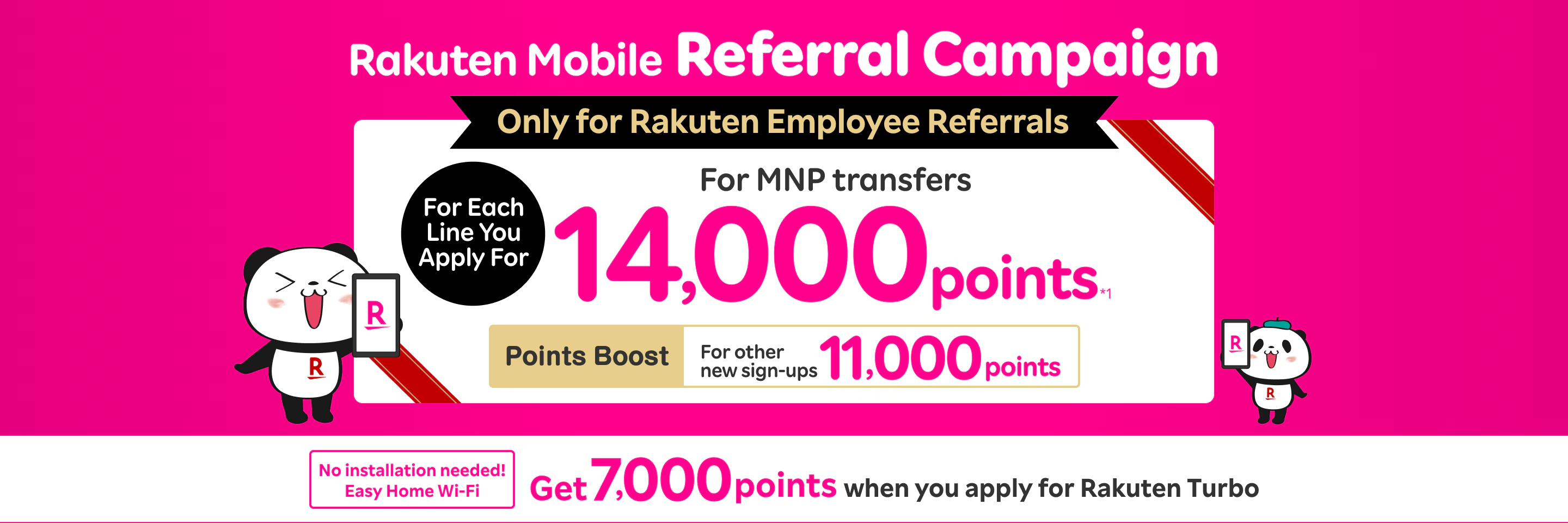
Rakuten Mobile Campaign

An Honest Look at the Pros and Cons

Pricing, speed, network quality, and weaknesses of 10 carriers — no sugarcoating

Overall SIM Ranking March 2026

Rated on pricing, speed, service quality, and point rewards. All prices include tax.

Rakuten Mobile
Saikyo Plan (MNO)
3 GB / 20 GB / Unlimited
¥968~
Unlimited ¥3,168
No cap
Unlimited
No contract
Cancellation fee ¥0
Pros
  • Unlimited data at ¥3,168/mo — one of the cheapest in Japan
  • Free domestic calls via the Rakuten Link app
  • Free roaming in 100+ countries (up to 2 GB)
  • Rakuten Ichiba SPU +5x points (huge if you shop on Rakuten)
  • Family discount −¥110/mo; kids' discount −¥440/mo
  • Tiered pricing from ¥968 for 3 GB — you only pay for what you use
Cons
  • Signal can be weak underground and inside buildings (Platinum Band rollout in progress)
  • Call quality on Rakuten Link is noticeably worse than VoLTE
  • Some areas still rely on au network roaming (not Rakuten's own network)
  • Fewer physical stores than the big three carriers
  • Point rewards are less useful if you don't use the Rakuten ecosystem
ahamo
docomo network (online only)
30 GB
Large option: 110 GB
¥2,970
Large ¥4,950
1 Mbps
after limit
No contract
Pros
  • Runs on docomo's network — top-tier coverage and speed
  • 5-minute call allowance included at no extra charge
  • 30 GB for ¥2,970 — simple, no surprises
  • Data roaming available in 82 countries
  • Among the fastest real-world speeds of any budget carrier
Cons
  • In-store support costs ¥3,300 per visit
  • Not eligible for docomo's family discount (only counted as a member)
  • No data rollover
  • No small plan — 30 GB is the minimum
  • No carrier email address
LINEMO
SoftBank network (Best Plan)
10 GB
V 30 GB
¥990~
V ¥2,970
1 Mbps
after limit
No contract
Pros
  • LINE messaging and calls don't count against your data (LINE Giga Free)
  • Reliable network quality on SoftBank's backbone
  • ¥990 for up to 3 GB — among the cheapest in the industry
  • Tiered pricing means you only pay for what you actually use
Cons
  • No in-store support at all (100% online)
  • Only two plan tiers — limited flexibility
  • No family discount
  • Voicemail and call forwarding are paid add-ons
IIJmio
Giga Plan (MVNO)
5 GB
2~50 GB available
¥950
2 GB from ¥850
200 kbps
after limit
No contract
Pros
  • Best cost per GB in the industry
  • Flexible tiers from 2 GB to 50 GB
  • eSIM support and easy multi-line management
  • Great selection of discounted phones sold with plans
  • Data sharing and rollover supported
Cons
  • Speed drops significantly during the lunch hour (common MVNO issue)
  • Almost no in-store support
  • Limited call plan options
  • Initial setup fee (SIM issuance charge) applies
mineo
My Pita / My Soku (MVNO)
7 GB
3~50 GB / Unlimited
¥1,518
3 GB from ¥1,298
200 kbps
after limit
No contract
Pros
  • "My Soku" plan offers unlimited data at up to 3 Mbps for just ¥990 (unique in Japan)
  • Choose from all three major networks (docomo / au / SoftBank)
  • Strong community support via the Mineoking user forum
  • "Free Tank" feature lets you share unused data with other users
Cons
  • My Soku is throttled to 32 kbps during the weekday lunch hour (essentially unusable)
  • Speed drops during peak hours like all MVNOs
  • Slightly more expensive than IIJmio
  • Limited 5G support
povo 2.0
au network (pay-as-you-go toppings)
On demand
3 GB ¥990 / 30 days
¥0~
Base fee ¥0
128 kbps
base speed
No contract
Pros
  • Base fee of ¥0 — perfect as a backup SIM
  • High-quality au network
  • 24-hour unlimited data pass for just ¥330 (great for travel days)
  • Costs nothing in months you don't use it
Cons
  • No monthly plan — buying data toppings each time can be a hassle
  • Data toppings have expiration dates
  • Your line may be suspended if you don't buy a topping for 180 days
  • No in-store support (100% online)
  • No unlimited calling option
UQ mobile
au network (sub-brand)
20 GB
Comicomi Plan
¥3,278
Mini Mini 4 GB from ¥2,365
1 Mbps
after limit
No contract
Pros
  • Reliable au network quality (not an MVNO)
  • In-person support at au and UQ shops nationwide
  • Data rollover supported
  • Home internet bundle discount available
Cons
  • Starting at ¥2,365 — more expensive than true MVNOs
  • Without bundle discounts, the price advantage is slim
  • Plan structure is a bit confusing
NTT docomo
docomo MAX / mini
Unlimited
mini 4 GB / 10 GB also available
¥7,315
mini from ¥1,628
1 Mbps
after limit
No contract
Pros
  • Best network quality and coverage in Japan
  • Full in-person support at docomo shops nationwide
  • Big discounts with family and fiber internet bundles
  • Strong d Point rewards ecosystem
Cons
  • Unlimited at ¥7,315 is more than double the budget carriers
  • Very expensive without any bundle discounts
  • Plan structure changes frequently and is hard to follow
au (KDDI)
Value Link Plan / Unlimited MAX+
Unlimited
Unlimited MAX+
¥7,238
Monthly (tax incl.)
1 Mbps
after limit
No contract
Pros
  • Generous entertainment bundles (Netflix, DAZN, etc.)
  • Strong nationwide network quality
  • In-person support at au shops
  • Ponta point integration
Cons
  • Monthly cost of ¥7,238+ is steep
  • Price doesn't drop even if you skip the entertainment extras
  • Plans are complex and hard to compare
SoftBank
Merihari Unlimited+
Unlimited
PayToku Unlimited also available
¥7,425
Monthly (tax incl.)
1 Mbps
after limit
No contract
Pros
  • High PayPay point cashback (with PayToku plan)
  • Stable network quality
  • In-person support at SoftBank shops
  • Yahoo! Premium benefits included
Cons
  • At ¥7,425/mo, the most expensive of the big three
  • PayToku Unlimited at ¥9,625 is extremely pricey
  • Not much value if you don't use PayPay

Rakuten Mobile's Coverage Problem — Is It Actually Getting Better?

"Rakuten doesn't work underground" — is that still true? Let's look at the latest data.

Population Coverage Over Time

2021
73%
Early days of the service
Heavily reliant on au roaming
2022
96%
Hit government target
4 years ahead of schedule
2023
99%
60,000+ base stations
Reached 99.9%
2024
99.9%
Platinum Band
(700 MHz) launched
2026
Expanding
95% of subway covered
Full completion by July

Subway & Indoor Coverage Improvements

Resolved (as of March 2026)
  • Tokyo Metro & Toei Subway: ~95% covered (100% expected by July)
  • Odakyu, Tokyu, Keisei, Rinkai, Keio, Sotetsu, Tokyo Monorail: underground sections 100% done
  • Bandwidth expanded from 5 MHz to 20 MHz (4x traffic capacity)
  • 83.2% of users report improved signal (+5.4 pts vs. 2024)
Still a work in progress
  • Platinum Band (700 MHz) is not yet deployed nationwide
  • Some rural areas still depend on au network roaming
  • Large malls and underground parking garages can still have dead spots
  • Indoor penetration still developing compared to Band 1/3/8 of the big three
Our take: Rakuten Mobile in 2026 is a very different beast from the "can't connect" reputation it had in 2021. Subway coverage in the Tokyo area is on track for full completion by July 2026. That said, if you live in a rural area or spend a lot of time inside large buildings, ahamo (docomo network) is still the safer bet. Check Rakuten Mobile's latest coverage map on their official site.

Which SIM Is Right for You?

Best value / Rakuten ecosystem users
Rakuten Mobile is the top pick. Unlimited data at ¥3,168 plus SPU point bonuses. Best if you don't spend much time underground.
Network quality above all else
ahamo is the best choice. Docomo's network delivers top speed and stability. 30 GB for ¥2,970.
Mostly use LINE / light data user
LINEMO. LINE data is free, and 3 GB starts at ¥990. Perfect if LINE is your main communication app.
Cheapest possible / low data needs
IIJmio or povo. IIJmio starts at ¥850 for 2 GB; povo can be maintained at ¥0/month.
Need in-person support
UQ mobile or Y!mobile. Walk into any au or SoftBank shop for face-to-face help.
Non-Japanese speaker / new to Japan
Rakuten Mobile (has English support) or ahamo (simple online sign-up). Both accept residence cards.

Frequently Asked Questions

Does Rakuten Mobile work in the subway?
As of March 2026, about 95% of Tokyo Metro and Toei Subway stations are covered, with full completion expected by July. Private railways like Odakyu, Tokyu, and Keisei have 100% underground coverage. That said, some underground shopping areas may still have spotty reception.
Why are MVNOs so slow at lunchtime?
MVNOs lease bandwidth from the major carriers, and that bandwidth gets congested when everyone is on their phone during the 12-1 PM lunch break. Carriers like ahamo, LINEMO, povo, and UQ mobile are not MVNOs, so they don't experience this slowdown.
Can foreigners sign up for these plans?
Yes — if you have a residence card (mid- to long-term resident status), you can sign up for virtually any plan listed here. Rakuten Mobile also offers English-language support, making the process smoother for non-Japanese speakers.
How do you decide the rankings on this site?
We evaluate each carrier based on pricing, network quality, user reviews, and unique features. While this site participates in affiliate programs, rankings are never influenced by commission rates. We list every carrier's drawbacks honestly.
Disclosure: This site participates in affiliate programs with the carriers listed. Rankings are determined by our editorial team independently. Accuracy: Information is current as of March 2026 and may change. Speeds listed are theoretical maximums.
Rakuten Mobile Campaign Apply Now →